What's the Most Accurate Way to Take a Child's Temperature? (Forehead vs Ear vs Armpit)
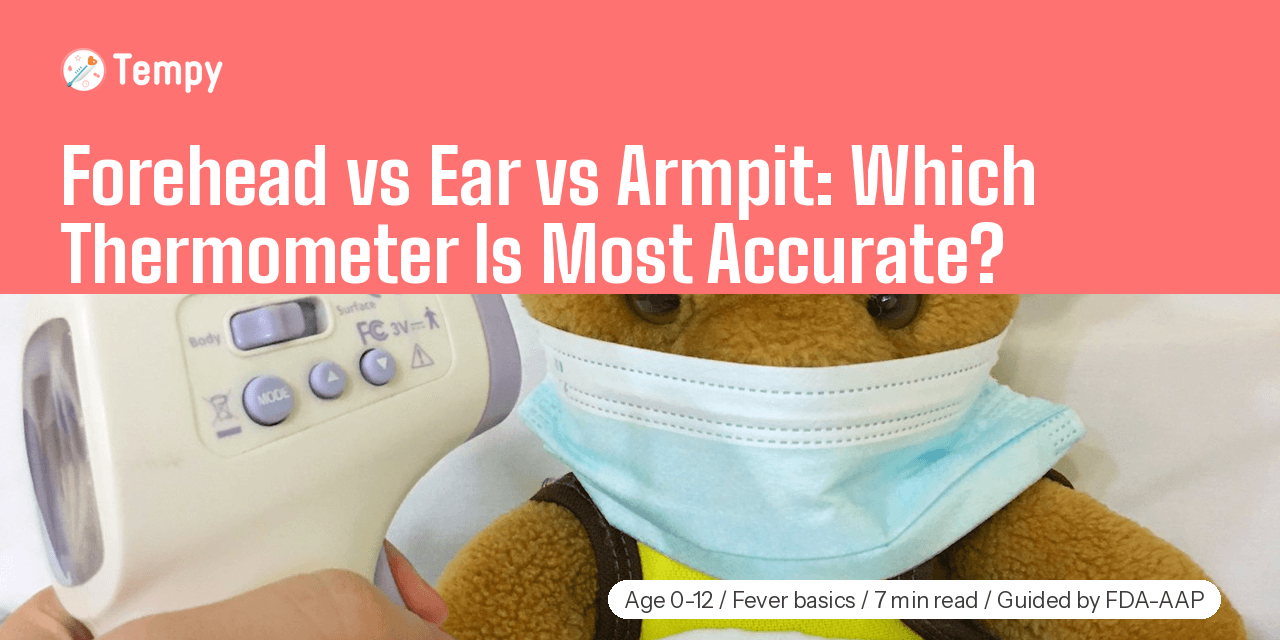
What's the Most Accurate Way to Take a Child's Temperature? (Forehead vs Ear vs Armpit)
Your child feels warm, you reach for the thermometer — and then the doubt creeps in. The forehead scanner says one thing, the ear reading says another, and now you're not sure whether you're dealing with a real fever or a measurement mistake. Take a deep breath. Different thermometers really do read differently, and that's normal, not a sign that yours is broken. The most accurate way to take a child's temperature depends mostly on their age, and once you know which method to trust at which stage, the confusing numbers start to make sense.
This post is general information, not medical advice. Tempy is built to support your judgment and help you track what you measure — it does not replace your pediatrician, who should always be your first call when something feels wrong.
What's the most accurate way to take a child's temperature?
The most accurate way to take a child's temperature is a rectal reading for babies under 3 months, because it most closely reflects true core body temperature. For older babies and children, the best method shifts toward ear, forehead, or oral readings as they get more practical, with armpit used as a quick screen rather than a precise measurement.
Accuracy is really about matching the method to the moment. A newborn with any fever is a serious situation where precision matters enormously, so the gold-standard rectal reading is worth the few seconds of fuss. A school-age child with cold symptoms doesn't need that same precision — a reliable forehead or ear reading is plenty to guide comfort care. Knowing this hierarchy means you stop chasing the "perfect" number and start using the right tool for your child's stage.
| Method | Best for (age) | Accuracy | Notes |
|---|---|---|---|
| Rectal | 0–3 months (gold standard) | Highest | Most accurate for newborns; use a dedicated rectal thermometer |
| Forehead (temporal) | 3 months and up | Good | Fast, non-invasive; technique-sensitive |
| Ear (tympanic) | 6 months and up | Good | Quick; less reliable with earwax or small ear canals |
| Oral | 4–5 years and up | Good | Requires a cooperative child who can hold it under the tongue |
| Armpit (axillary) | Any age (screening only) | Lowest | Useful first check; confirm a borderline reading another way |
Are forehead (temporal) thermometers accurate for kids?
Yes — modern forehead (temporal artery) thermometers are reasonably accurate and well suited to children over 3 months, as long as you use them correctly. They scan the heat of the blood flowing near the surface of the temple, give a result in seconds, and don't require waking or undressing a sleeping child, which makes them a favorite for nighttime checks.
Their main weakness is technique. A forehead covered in sweat, a child who just came in from outside, or a sensor held too far from the skin can all throw off the reading. For the most reliable result, wipe away sweat, keep the child somewhere with a stable room temperature for a few minutes first, and follow the exact distance and swipe motion in the device's instructions. Forehead "no-touch" scanners are convenient but tend to be a little more sensitive to drafts and positioning than the contact temporal-artery models.
How accurate are ear (tympanic) thermometers?
Ear (tympanic) thermometers are accurate for children 6 months and older when positioned well, because the eardrum shares a blood supply with the brain's temperature center and reflects core temperature closely. They read in one to two seconds, which is a real advantage with a squirming toddler.
The catch is fit and placement. A young baby's ear canal is too small and curved for a reliable reading, which is why ear thermometers aren't recommended under 6 months. Earwax, a recent ear infection, or a probe that isn't aimed correctly down the canal can all skew the number. A helpful trick: gently pull the outer ear up and back (down and back for babies over 6 months) to straighten the canal before you take the reading, and take it in the same ear each time so your day-to-day comparisons stay consistent.
Is an armpit temperature reading reliable?
An armpit (axillary) reading is the least accurate method and tends to run lower than your child's true core temperature, often by about 1°F (around 0.5°C). It works well as a quick, non-invasive first screen — especially for a sleeping baby — but it shouldn't be the final word on whether a young child has a fever.
Use the armpit reading as a tripwire, not a verdict. If it shows anything at or near a fever, or if your child seems unwell despite a "normal" armpit number, confirm with a more accurate method for their age. For a baby under 3 months, a borderline armpit reading should always be rechecked rectally, because at that age the exact number genuinely changes what you should do next. To take an armpit reading properly, place the tip in the center of a dry armpit, hold the arm snugly against the body, and wait for the full beep.
What counts as a fever for each method?
A fever is generally defined as 100.4°F (38°C) or higher, but because methods read slightly differently, the practical threshold shifts a little depending on how you measured. Rectal and ear readings run closest to true core temperature, oral runs slightly lower, and armpit lowest of all — so the same child can show different numbers within minutes.
These commonly cited general thresholds help you interpret what you see:
- Rectal, ear, or temporal: 100.4°F (38°C) or higher
- Oral: about 100°F (37.8°C) or higher
- Armpit: about 99°F (37.2°C) or higher
What matters most is consistency and trend, not chasing a single decimal. Pick the right method for your child's age, use it the same way each time, and watch the pattern across the day. One number is a snapshot; a trend is the story — and the trend is what actually tells you whether an illness is building or fading.
Why do two thermometers give me different readings?
Two thermometers give different readings mainly because they measure different parts of the body, and each site naturally runs warmer or cooler than the others. A forehead, an eardrum, and an armpit are simply not the same temperature at the same moment, so a 1–2°F gap between methods is expected and usually not a malfunction.
Other everyday culprits add to the spread: a low battery, a dirty or smudged sensor lens, earwax, sweat, a child who was just bundled in blankets or crying hard, or readings taken minutes apart while the fever itself is rising. Rather than trusting whichever number is scariest, choose one method that fits your child's age and use only that one for tracking. Logging readings from the same method over time — something Tempy makes effortless with one-tap entries — turns a pile of conflicting numbers into a single, trustworthy line you can actually read.
Which thermometer should I use for my child's age?
Match the thermometer to your child's age: rectal for newborns under 3 months, forehead from about 3 months, ear from about 6 months, and oral once your child is old enough (usually 4–5) to hold the probe under their tongue without biting it. Armpit works as a screening method at any age. This age-based approach gives you the accuracy you need exactly when you need it most.
A simple by-age cheat sheet:
- Under 3 months: Rectal is the gold standard. At this age, any fever of 100.4°F (38°C) or higher is a medical emergency — call your pediatrician or seek care immediately, do not manage it at home.
- 3 to 6 months: Forehead or rectal. Call your pediatrician for any fever over 102°F (38.9°C), even if your baby seems otherwise fine.
- 6 months to 4 years: Forehead or ear for everyday checks; armpit as a quick screen.
- 4–5 years and up: Oral becomes reliable once your child can cooperate; forehead and ear still work well.
Whatever you choose, the disclaimer worth repeating is this: a thermometer measures temperature, not how sick your child is. A calm, alert, drinking child at 103°F is usually more reassuring than a limp, gray, inconsolable child at 101°F. Always pair the number with how your child looks and behaves — and call your pediatrician or 911 right away for any fever paired with a stiff neck, a non-fading rash, trouble breathing, a seizure, or unusual limpness.
How do I take an accurate temperature at home?
To get an accurate reading at home, pick the right method for your child's age, prepare the site (clean sensor, dry skin, settled child), follow the device's instructions exactly, and wait for the full beep before reading. Let your child rest indoors for a few minutes first, since coming in from the cold or heat can temporarily skew the result.
A few habits that make every reading more trustworthy: take temperatures at consistent times — for example morning, late afternoon, and bedtime — so you can see the daily rhythm instead of reacting to one spike; keep the device clean and the battery fresh; and write down the time, the method, and the number every time. That last step is where most exhausted parents slip, especially at 2 a.m. Tempy keeps the whole timeline in one place, tags each reading by method, and shares it instantly with a co-parent or caregiver — so when the pediatrician asks "what's the pattern been?", you have a clear answer instead of a guess.
Try Tempy
Tempy turns scattered, second-guessed thermometer readings into one calm, trustworthy timeline. Log each temperature in a tap, tag the method so your numbers stay comparable, see the day-by-day trend instead of one alarming spike, get weight-based medication reminders that respect FDA/AAP intervals, and share everything with the other parent so no one has to ask "wait, what did the last reading say?"
Frequently Asked Questions
What is the most accurate way to take a child's temperature?
For babies under 3 months, rectal temperature is the most accurate method as it reflects true core body temperature. For older children, forehead (temporal), ear (tympanic), or oral thermometers are appropriate depending on age, while armpit readings are best used only as quick screening tools.
Are forehead thermometers reliable for children?
Yes, forehead (temporal artery) thermometers are reasonably accurate for children over 3 months when used correctly. They provide quick, non-invasive readings but require proper technique, such as wiping away sweat and following the device instructions closely to avoid inaccurate results.
How accurate are ear thermometers for kids?
Ear (tympanic) thermometers are accurate for children 6 months and older when positioned correctly, as the eardrum temperature closely reflects core body temperature. However, earwax, infections, or improper placement can affect accuracy, so it's important to straighten the ear canal and use the same ear consistently.
Is an armpit temperature reading reliable for detecting fever?
Armpit (axillary) readings are the least accurate and tend to be lower than core body temperature by about 1°F (0.5°C). They are useful for quick screening but should be confirmed with a more accurate method, especially in young infants or if the child appears unwell.
Why do different thermometers give different temperature readings?
Different thermometers measure temperature at various body sites, each naturally running warmer or cooler, causing expected 1–2°F differences. Factors like sensor cleanliness, battery life, recent activity, and technique also influence readings, so it's best to use one method consistently to track trends accurately.
Continue reading

What Is Roseola? The Fever-Then-Rash Pattern in Babies and Toddlers
Roseola causes a sudden high fever in babies and toddlers, then a pink rash once it breaks. Here's what's normal, how it spreads, and when to call the doctor.
How Much Fever Medicine Should I Give My Child? (Dosing by Weight)
Fever medicine for kids is dosed by weight, not age. Here is why the package chart falls short, how to measure accurately, and what to do if you think you gave too much.
Child Has a Fever but No Other Symptoms? What It Usually Means
Your child has a fever but no other symptoms - no cough, no rash, nothing. What that usually means, how long it lasts, and when to call the doctor.