Can an Ear Infection Cause a High Fever in Kids? (What to Watch For)
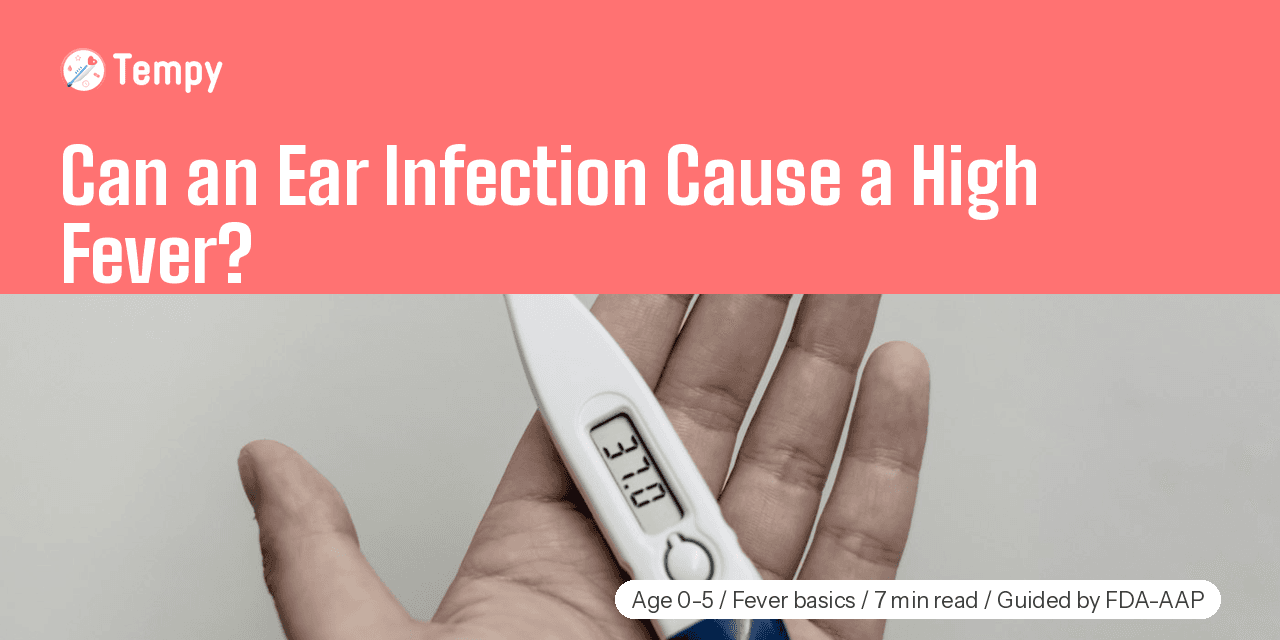
Can an Ear Infection Cause a High Fever in Kids? (What to Watch For)
Your child has been off all day — clingy, not eating, tugging at one ear — and now the thermometer reads 102.6°F. Somewhere in the back of your mind a familiar suspicion forms: is this their ear again? Take a deep breath. Ear infections are one of the most common reasons a young child spikes a fever, and the pattern they follow is recognizable once you know what to look for.
This post is general information and does not replace a conversation with your child's doctor. Tempy exists to help you capture the pattern — each reading, each dose, each symptom on one timeline — so what you bring to the pediatrician is a record rather than a fuzzy memory of a long night.
Can an ear infection cause a high fever in children?
Yes. A middle ear infection can push a child's temperature to 102–104°F, especially in the first day or two. Fever is one of the body's standard responses to the infection behind the eardrum. That said, plenty of ear infections cause only a mild fever, and some cause none at all.
This surprises a lot of parents, because "ear infection" sounds like a small, local problem. It isn't small to the immune system. Fluid gets trapped behind the eardrum, bacteria or viruses multiply in it, pressure builds, and the whole body responds — fever included.
Ear infections are also extremely common. According to the National Institute on Deafness and Other Communication Disorders, roughly five out of six children have at least one ear infection by their third birthday. If this is your second or third round, you are firmly in normal territory.
The reason toddlers get them so often is anatomical. The eustachian tube — the little drainage channel between the middle ear and the back of the throat — is short, narrow, and nearly horizontal in young children. Fluid from a cold sits there instead of draining. By school age the tube lengthens and tilts, and the frequency drops off on its own.
How can I tell if my child's fever is coming from their ear?
Look for a fever that arrives a few days into a cold, paired with a focused complaint: one ear tugged or rubbed, pain that gets worse lying flat, sudden night waking, or fluid draining from the ear. Ear infections usually follow a cold rather than starting the illness.
That timing detail is the most useful clue a parent has. A typical sequence looks like this: runny nose and cough for three or four days, things start to seem better, and then a new fever appears along with fussiness and ear-directed behavior. The cold congested the eustachian tube; the trapped fluid became infected.
Signs by age, since a two-year-old cannot tell you their ear hurts:
| Age | What it often looks like |
|---|---|
| Under 12 months | Pulling or batting at one ear, inconsolable crying, worse when laid down, poor feeding, waking repeatedly |
| 1–3 years | Tugging one ear, refusing to lie flat, new night waking, off balance or clumsy, appetite drop |
| 3+ years | Says the ear hurts or feels "full," muffled hearing, asks for the TV louder, complains more at bedtime |
| Any age | Yellow or bloody fluid draining from the ear canal — call the doctor |
Two caveats worth holding lightly. Ear-pulling alone is not proof: babies tug at their ears when teething, when tired, and sometimes just because ears are interesting. And a child can have a genuine ear infection while touching their ear exactly zero times. The combination — recent cold, new fever, pain that spikes when lying down — is far more telling than any one sign by itself.
The one thing no parent can do from home is see the eardrum. That is a thirty-second look with an otoscope, and it is why the diagnosis lives at the pediatrician's office rather than in a search bar.
How high does a fever usually go with an ear infection?
Most run in the 100.4–102.5°F range, though 103°F or higher happens, particularly on the first day. Fever height does not reliably indicate how severe the infection is or whether antibiotics will be needed. How your child looks and acts between fever spikes matters far more than the number.
Pediatricians weigh appearance and behavior over the reading itself. A child at 103°F who drinks, plays a little, and settles once fever medicine takes effect is generally less concerning than a child at 100.8°F who is limp, refuses fluids, and cannot be roused for a favorite snack.
The exception is absolute: any fever of 100.4°F (38°C) or higher in an infant under three months requires same-day medical evaluation, regardless of how well the baby seems and regardless of what you suspect is causing it. There is no home-management path at that age.
Does every ear infection need antibiotics?
No. The American Academy of Pediatrics supports "watchful waiting" for many children over the age of two with mild symptoms — treating the pain and observing for 48 to 72 hours, since a majority of ear infections resolve without antibiotics. Younger children, severe pain, or both ears affected typically shift the decision toward treating.
This is one of the most common points of friction in the exam room, so it helps to know the reasoning. Many ear infections are viral, and antibiotics do nothing against viruses. Even bacterial ones frequently clear on their own once the fluid drains. Prescribing anyway brings side effects — diarrhea, rash, disrupted gut bacteria — and contributes to antibiotic resistance without shortening the illness.
Factors that generally push toward antibiotics right away: age under two, especially under six months; severe ear pain; fever of 102.2°F or higher; both ears involved; fluid draining from the ear; or symptoms that have already dragged on. Your pediatrician weighs these together after actually looking at the eardrum.
Some offices offer a middle path: a "safety net" prescription you fill only if things have not improved in two or three days. If you are on the watchful-waiting track, a log of temperatures and pain levels turns that follow-up call into something concrete — "he was 102 for two days and now he's 103 and won't eat" carries far more weight than "he still seems bad."
Whichever path you're on, comfort is the immediate goal. Fever and pain medicine exist to help a child drink, rest, and sleep, not to force a number down to a target. FDA and AAP guidance describes acetaminophen roughly every four to six hours and ibuprofen roughly every six to eight hours, with any alternating schedule spaced and supervised. Exact amounts are weight-based and belong to your pediatrician and the packaging for your child's specific product — never to a blog post.
How long does an ear infection fever last?
Fever typically improves within 48 to 72 hours, whether or not antibiotics are used. With antibiotics, most children turn a corner in one to two days. A fever still climbing after three days, or one that returns after your child seemed better, is worth a call back.
Two things commonly outlast the fever, and both are normal. Fluid can sit behind the eardrum for weeks after the infection clears, which may mean temporarily muffled hearing — your pediatrician will usually recheck it rather than treat it again. And mild ear discomfort can linger a few days past the last fever.
What is not expected: a fever that keeps rising past day three, a fever that resolves and then comes back, or new symptoms appearing — swelling or redness behind the ear, a stiff neck, a severe headache, or a child who is unusually difficult to wake.
What helps my child's ear pain at home tonight?
Keep their head elevated, offer plenty of fluids, and use age-appropriate pain relief per your pediatrician. Many children are more comfortable sleeping propped slightly upright, since lying flat increases the pressure behind the eardrum. A warm compress held against the outer ear often helps too.
A few practical things that make a hard night easier:
- Prop the head up. For toddlers and older children, an extra pillow or a slightly inclined mattress can meaningfully reduce pain. Never use pillows or inclined sleepers for infants — flat, firm, and on the back remains the safe-sleep rule.
- Warm compress. A warm (not hot) washcloth against the outer ear for ten to fifteen minutes.
- Fluids over food. Appetite drops with ear pain because swallowing and chewing hurt. Prioritize hydration and let solid food wait.
- Cold and soft. Yogurt, smoothies, ice pops — cold soothes, and no chewing required.
- Skip the ear drops unless your pediatrician specifically prescribed them. Nothing goes in the ear canal without a doctor confirming the eardrum is intact.
Note the time of every dose. Ear infection nights are exactly when doses get double-given or forgotten, because two exhausted adults are trading off in the dark.
When should I call the doctor about an ear infection?
Some situations skip the wait-and-see entirely. Call your pediatrician — or 911 for anything severe — if any of these appear:
- An infant under 3 months with any fever at or above 100.4°F (38°C)
- Swelling, redness, or tenderness of the bone behind the ear, or an ear that begins to stick out
- Stiff neck, severe headache, or a rash that does not fade when pressed with a clear glass
- A child you cannot fully wake, or who is limp and unresponsive
- A seizure, or difficulty breathing
- Fluid, pus, or blood draining from the ear canal
- Fever lasting more than 3 days on antibiotics, or returning after a fever-free stretch
- Signs of dehydration — no wet diaper or urine for 8 hours, no tears when crying, sunken eyes
- Your own sense that something is different from every previous ear infection
That last one belongs on the list. Parents notice things checklists miss, and no pediatric office will mind the call.
Try Tempy
Tempy is a calm, private fever log built for stretches exactly like this one — the ones where you cannot remember whether that 103 was Tuesday afternoon or Wednesday morning, or which parent gave the last dose. Log each reading and each dose in two taps, watch the curve take shape, and share it with a co-parent or your pediatrician instantly. It supports your care decisions; it never substitutes for your child's doctor.
- iOS: Download Tempy on the App Store
- Android: Get Tempy on Google Play
- Web: eodin.app/tempy
Frequently Asked Questions
Can an ear infection cause a high fever in children?
Yes, middle ear infections can cause a fever ranging from 102°F to 104°F, especially in the first couple of days. However, some ear infections cause only mild or no fever at all.
How can I tell if my child's fever is due to an ear infection?
Look for a fever that appears a few days into a cold, combined with signs like tugging or rubbing one ear, pain worsening when lying flat, night waking, or fluid draining from the ear. Ear infections usually follow a cold rather than starting the illness.
Does every ear infection require antibiotics?
No, many ear infections resolve without antibiotics, especially in children over two with mild symptoms. Antibiotics are typically recommended for younger children, severe pain, high fever, both ears affected, or fluid draining from the ear.
How long does a fever from an ear infection usually last?
Fever from an ear infection generally improves within 48 to 72 hours, whether or not antibiotics are used. If the fever lasts longer than three days, returns after improvement, or new symptoms develop, contact your pediatrician.
When should I call the doctor about my child's ear infection?
Call your pediatrician immediately if your child is under 3 months with a fever over 100.4°F, has swelling or redness behind the ear, fluid draining from the ear, severe headache, stiff neck, difficulty waking, seizures, or signs of dehydration. Also call if fever lasts more than three days or returns after improvement.
Continue reading
What Is Roseola? The Fever-Then-Rash Pattern in Babies and Toddlers
Roseola causes a sudden high fever in babies and toddlers, then a pink rash once it breaks. Here's what's normal, how it spreads, and when to call the doctor.
How Much Fever Medicine Should I Give My Child? (Dosing by Weight)
Fever medicine for kids is dosed by weight, not age. Here is why the package chart falls short, how to measure accurately, and what to do if you think you gave too much.
Child Has a Fever but No Other Symptoms? What It Usually Means
Your child has a fever but no other symptoms - no cough, no rash, nothing. What that usually means, how long it lasts, and when to call the doctor.